INDUSTRY NEWS
China Application of Lightning Strike Counter At Bess Solar PV Power Plant Project
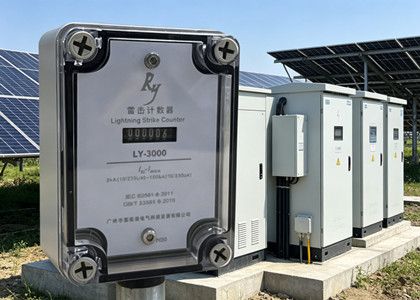
Application of Lightning Strike Counters in Photovoltaic and Energy Storage Systems
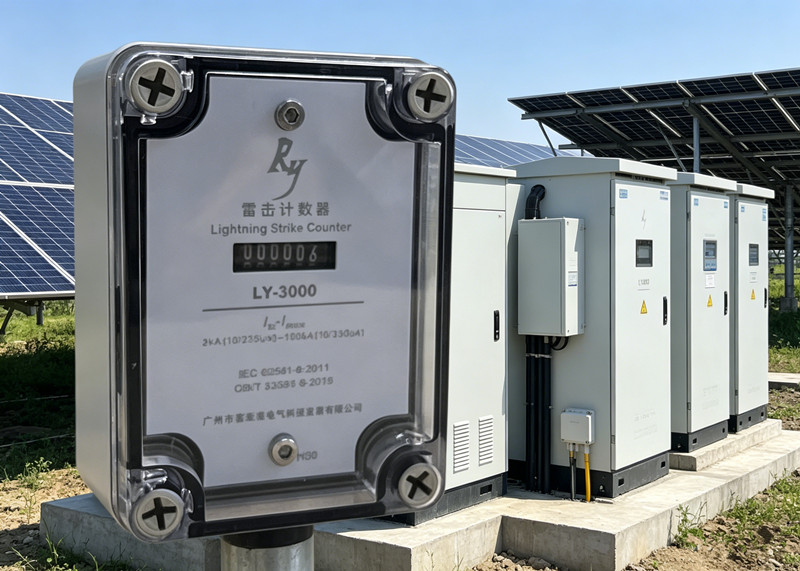
A lightning strike counter is a key monitoring device used in photovoltaic (PV) and energy storage systems to quantify lightning events, evaluate lightning protection performance, and guide operation, maintenance and risk analysis. It usually works in conjunction with lightning rods, SPDs and grounding grids to form a complete closed loop of lightning protection and monitoring.
1.Why PV and Energy Storage Systems Need Lightning Strike Counters
●High-risk scenarios
○PV modules and energy storage containers are mostly installed in open rooftops, mountains or deserts, with high exposure to direct lightning and induced lightning.
Energy storage systems include lithium batteries, BMS, PCS, high-voltage cabinets and other precision electronics, which are vulnerable to breakdown, fire and thermal runaway caused by lightning surges.
The system features high DC voltage and long cables, resulting in strong induced overvoltage and multiple conduction paths.
●Blind spots of traditional lightning protection
Only knowing that “SPDs / lightning rods are installed”, but unaware of the number of strikes, intensity, affected circuits and occurrence time.
Unable to judge whether lightning protection is effective, SPDs are aging, grounding is reliable, or reinforcement is required.
2.Working Principle (for PV and Energy Storage)
●Inductive type (mainstream)
○A through-core coil is installed on the down conductors of lightning rods, SPD grounding cables or main grounding busbars.
○When lightning current (≥1kA, 8/20μs) passes through, a strong pulsed magnetic field is generated to trigger counting.
●Types and applications
○Passive mechanical type: No power supply required, strong anti-interference, data retention after power failure — suitable for remote PV power stations without utility power.
○Electronic / digital display type: With LCD screen, time and amplitude recording — suitable for centralized energy storage stations.
○Intelligent type (recommended): RS485 / NB-IoT, remote data upload, event logging — integrated into PV / energy storage monitoring platforms.
3. Installation Locations in PV and Energy Storage Systems
1.External direct lightning circuits
○Down conductors of lightning rods / strips on PV arrays (one counter per down conductor).
○Down conductors of lightning meshes on the top of energy storage containers.
2.Internal surge (SPD) circuits
○Grounding terminals of DC-side SPDs in combiner boxes.
○Grounding terminals of DC / AC-side SPDs in inverters.
○Grounding terminals of SPDs for PCS, BMS, battery clusters and high-voltage cabinets in energy storage systems.
○Grounding terminals of incoming SPDs at grid connection points / box-type transformers.
3.Main grounding grid
Main grounding busbars and common grounding down conductors of the whole station.
4.Core Application Values
●Lightning data statistics and risk assessment
○Count annual / seasonal / monthly lightning strike times to determine regional thunderstorm levels.
○Locate circuits / equipment with high lightning frequency (e.g., combiner boxes in certain areas, BMS in certain containers).
○Provide data support for lightning protection design, site selection and rectification.
●Verification of lightning protection system effectiveness
○Normal equipment operation after lightning strikes indicates effective SPDs, grounding and equipotential bonding.
○Equipment failure after lightning strikes indicates insufficient protection, SPD failure or poor grounding.
○Comparison: counter readings ≈ SPD operating times means normal matching; large deviation means hidden dangers.
●Guiding precise operation and maintenance (cost reduction and efficiency improvement)
○Avoid blind inspection: Determine whether SPDs, insulation and grounding need inspection based on counting data.
○SPD lifecycle management: Replace SPDs in advance after multiple lightning strikes to prevent failure and fire.
○Fault tracing: Check time, frequency and circuits to quickly locate causes when equipment is damaged by lightning.
●Safety and compliance
○Meet lightning monitoring requirements of GB/T 21714.6, IEC 62561-6.
○Provide lightning event records for insurance claims, accident analysis and safety audits.
○Meet high safety standards of energy storage: support linkage with BMS / PCS for early warning or shutdown under strong lightning strikes.
5.Intelligent Lightning Strike Counters (Preferred for PV and Energy Storage)
●Functions
○Record: time, frequency, current amplitude, polarity and waveform.
○Communication: RS485, LoRa, NB-IoT, MQTT — connected to SCADA / cloud platforms.
○Alarm: local audible and visual alarm + remote APP / SMS notification.
○Power supply: battery + PV self-power supply for long endurance.
●Typical deployment
○One counter for each combiner box, inverter, energy storage container and box-type transformer.
○Platform visualization: lightning distribution map, trends, alarms and reports.
6.Selection and Installation Guidelines
●Selection
○Lightning current range: 500A~200kA (covering lightning current levels in PV and energy storage).
○Protection grade: IP65 (outdoor / cabinet use).
○Response waveform: 8/20μs, 10/350μs (direct and induced lightning).
○Energy storage scenario: with event storage, remote communication and BMS linkage.
●Installation
○Install on grounding down conductors and SPD grounding cables, away from strong current / magnetic fields.
○Ensure firm wiring, reliable grounding, and waterproof and anti-corrosion treatment.
○For intelligent types: perform regular time calibration, data upload and battery maintenance.
7.Summary
Lightning strike counters transform lightning protection for PV and energy storage from passive protection to monitorable, quantifiable and manageable. They are especially critical for large-scale ground PV plants, industrial and commercial energy storage stations and mountain PV power stations: they ensure the safety of lithium batteries and power electronic equipment, and realize precise operation and maintenance, controllable risks and compliant records.