INDUSTRY NEWS
Why Early Streamer Emission (ESE) Air Terminals Provide a Larger Lightning Protection Radius
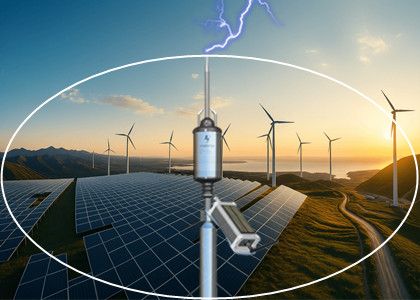
Why Early Streamer Emission (ESE) Air Terminals Provide a Larger Lightning Protection Radius
Early Streamer Emission (ESE) air terminals offer a larger lightning protection radius mainly because they initiate an upward streamer much earlier than conventional lightning rods, thereby “capturing the lightning first” in space and extending the effective coverage area.
Core Principles & Key Reasons
1. Early Streamer Effect (ΔT)
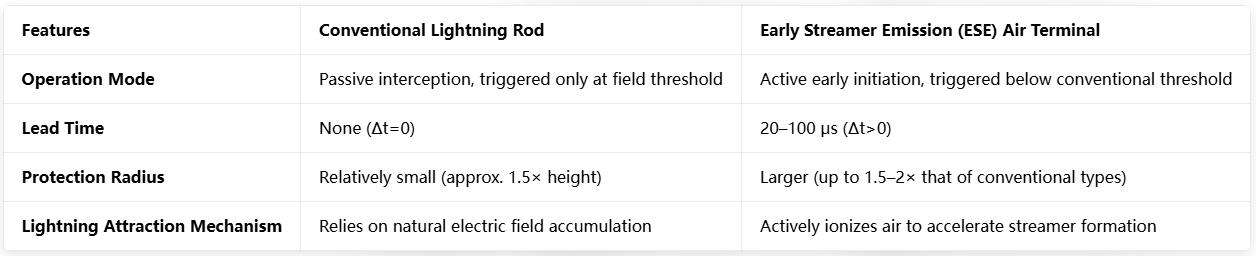
When a downward stepped leader from a thundercloud approaches the ground, a conventional lightning rod only emits an upward streamer after the electric field reaches a threshold. By contrast, an ESE terminal — through its special structure (induction electrodes, high-voltage pulse triggering) — launches an upward streamer 20–100 microseconds in advance, before the electric field reaches the conventional threshold. This lead time (Δt) creates a valuable window for lightning attraction, moving the streamer meeting point farther away and effectively increasing the protection radius.
2. Active Electric Field Enhancement
The electric field is highly concentrated at the ESE tip, ionizing the surrounding air and forming a conductive path. This actively enhanced electric field allows it to form an upward streamer sooner than surrounding objects (including conventional rods), ensuring priority lightning interception.
3. Equivalent Virtual Height Increase
Due to early streamer emission, the effective “starting point” of the ESE terminal extends upward, equivalent to raising its virtual intercepting height. Since the protection radius is positively related to the intercepting height under the rolling sphere method, an ESE terminal achieves a significantly larger protection range than a conventional lightning rod at the same mounting height (typically 1.5–2 times greater).
Comparison with Conventional Lightning Rods
Important Notes
The expanded protection range of ESE terminals depends on its early streamer emission time ΔT, which varies by model (e.g., 25μs, 35μs, 45μs). Its protection range is usually calculated using the rolling sphere method combined with the equivalent early distance (D) converted from Δt.