INDUSTRY NEWS
Function of Early Streamer Emission (ESE) Lightning Rods in PV Energy Storage Systems
Function of Early Streamer Emission (ESE) Lightning Rods in PV Energy Storage Systems
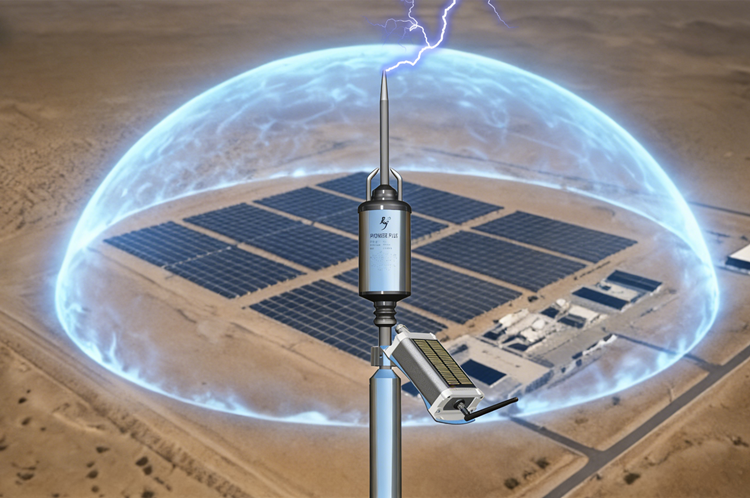
Early Streamer Emission (ESE) lightning rods are core active protection devices against direct lightning strikes for photovoltaic (PV) energy storage systems. Their key function is to actively trigger lightning discharge in advance, expand the protection range, and reduce the risk of lightning bypass, providing more reliable direct lightning protection for key equipment such as open‑air PV modules, energy storage containers, and box-type transformers.
I. Core Working Principle (Preemptive Protection)
Unlike conventional lightning rods that “passively wait for lightning”, ESE adopts an active intervention mechanism:
- Electric field induction and energy storage: When a thundercloud approaches, the device senses and stores electric field energy.
- Early ionization triggering: When the electric field reaches a critical value (approx. 10–20 kV/m), the internal trigger releases high‑voltage pulses to form an upward leader at the tip.
- Preemptive lightning capture: The artificial upward leader connects with the downward leader from the thundercloud dozens of microseconds in advance, guiding the lightning current precisely to itself.
- Safe discharge: The lightning current is quickly discharged into the ground through down conductors and the grounding grid.
II. Key Roles in PV Energy Storage
1. Direct Lightning Protection: Active Interception to Avoid Equipment Damage
- Precise lightning guiding: Fixes the lightning strike point on the lightning rod, preventing direct lightning hits on core equipment such as PV modules, energy storage battery clusters, and inverters.
- Reducing bypass / side strikes: The actively formed ionization channel significantly lowers the probability of lightning bypassing the rod to strike equipment (to less than 1/5 that of conventional rods).
- Protecting high‑value assets: Prevents catastrophic failures such as thermal runaway of batteries, breakdown of modules, and burnout of box-type transformers caused by lightning.
2. Expanded Protection Range for Large‑Scale Station Layout
- Protection radius increased by 30%–100% at the same height (protection angle 55°–65°, compared to ≤45° for conventional types).
- Fewer installations: Covers the same area of PV arrays or energy storage container groups with far fewer lightning rods, reducing overall costs.
- Suitable for distributed layouts: Ideal for complex terrain and scattered equipment in mountainous, high‑altitude, and desert PV energy storage plants.
3. Improving System Safety and Reliability
- Reducing power interruptions: Avoids equipment shutdown and line tripping caused by lightning, ensuring stable continuous power generation and grid connection.
- Lowering operation and maintenance costs: Reduces expenses for repair and replacement after lightning damage, especially in high‑altitude and high‑lightning‑density areas.
- Adaptable to harsh environments: High wind resistance, seismic resistance, and weather resistance; stable operation in areas with high soil resistivity (relaxed allowable grounding resistance).
4. Cooperating with Internal Lightning Protection for a Complete System
ESE serves as the first line of external (direct strike) lightning protection and must coordinate with internal (induced lightning) protection:
- Cooperate with multi‑stage SPD surge protective devices (DC side, AC side, communication lines) to discharge induced lightning and residual voltage.
- Cooperate with equipotential bonding and common grounding grid (grounding resistance ≤4Ω) to eliminate potential differences and prevent backflashover.
III. Selection and Application Guidelines
- Standards: Comply with Early Streamer Emission Lightning Rods (QX/T 106-2009) and PV energy storage lightning protection specifications.
- Installation location: Install at commanding points such as the periphery of PV arrays, tops of energy storage containers, and four corners of box-type transformers, at least 1.5 m higher than protected objects.
- Grounding requirements: Must be reliably connected to a low‑resistance, stable grounding grid to ensure rapid discharge of lightning current.