INDUSTRY NEWS
China ESE Air Terminal LY-ESE3.0 to Protectect BESS Energy Storage Photovoltaic Power Plant
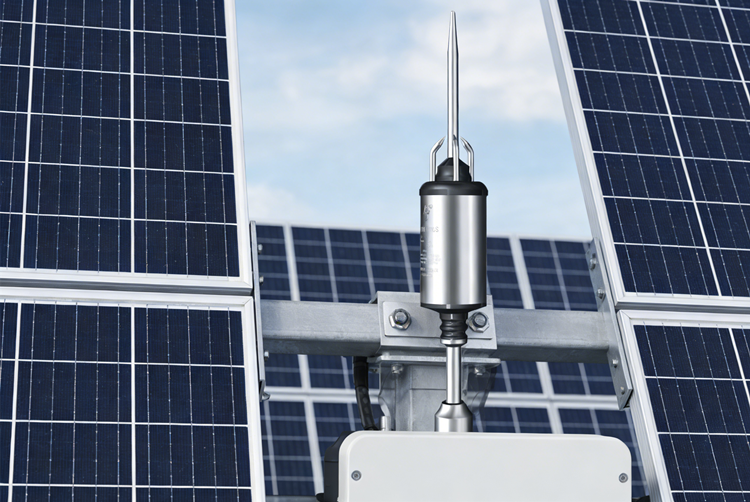
Working Principle of the Early Streamer Emission Lightning Rod
The core principle of the Early Streamer Emission (ESE) Lightning Rod is to actively generate an upward streamer and preemptively connect with it before the downward streamer from the thundercloud arrives, thereby intercepting the direct lightning strike more accurately and within a wider protection range. The lightning current is then safely discharged to the ground through the down conductor and grounding device. The detailed working principle is as follows:
Electric Field Induction and Energy Accumulation
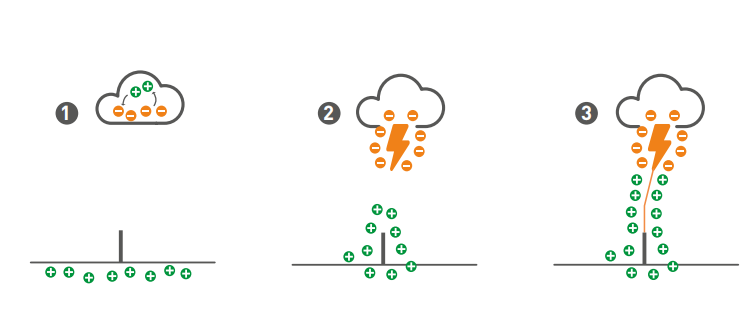
When a thundercloud approaches, a strong electric field (up to over 10 kV/m) is formed between the cloud and the ground. The induction device at the top of the lightning rod (such as a multi-needle or ring electrode) senses the electric field and accumulates energy, creating a significant potential difference between the exciter and the tip of the main rod.
When the electric field intensity reaches the threshold value (usually 10–50 kV/m), the energy storage structure releases energy, causing an abrupt change in the electric field at the tip of the main rod and creating conditions for early streamer emission.
Air Ionization and Upward Streamer Generation
The special structure of the lightning rod tip (e.g., multi-needle design, ion generator) highly concentrates the electric field at the tip (up to 10^7 V/m, far exceeding the 10^4 V/m on the surface of ordinary conductors), which easily triggers corona discharge and releases a large number of charged ions.
These ions accelerate under the action of the thundercloud electric field, reducing the air breakdown threshold, and forming a conductive plasma channel in advance, thus generating an upward-propagating streamer whose speed is much faster than the natural streamer of a conventional lightning rod.
This upward streamer extends toward the thundercloud with a microsecond-level lead time (△T), seizing the opportunity to connect with the downward streamer.
Lightning Capture and Safe Current Discharge
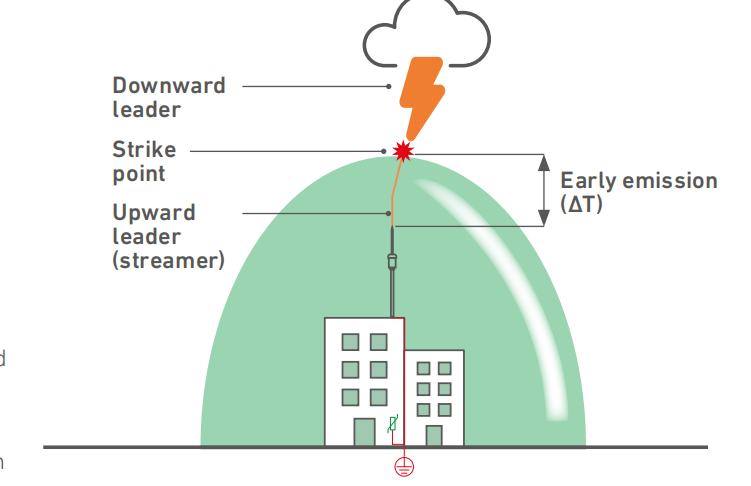
After the upward streamer meets the downward streamer from the thundercloud, a complete discharge channel is formed, making the lightning rod the preferred strike point for lightning.
The lightning current flows through the lightning receptor and down conductor, and is finally safely conducted to the ground through the grounding device, preventing the protected object from being damaged by direct lightning strikes.
Core Advantages
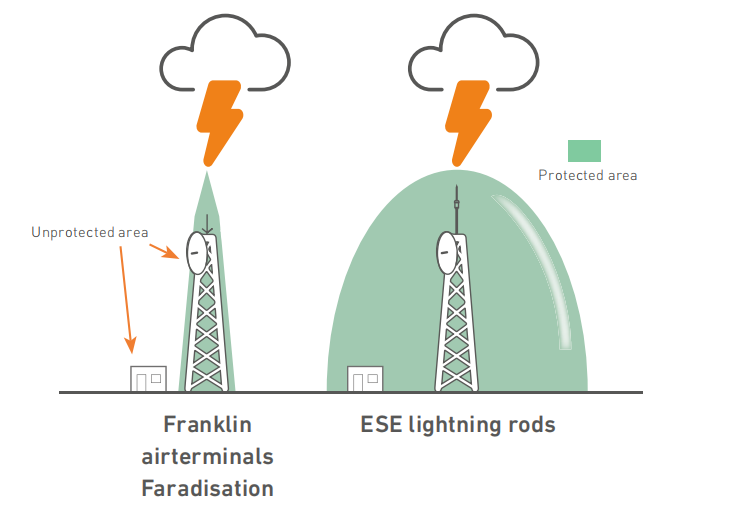
It has a larger protection radius at the same height and more stable lightning interception performance, which can effectively reduce the probability of side strikes or shielding failures on the protected object.
Most ESE lightning rods adopt a passive design, which is triggered by the energy of the thundercloud electric field without requiring an external power supply, making installation and maintenance convenient.