COMPANY NEWS
BESS Lithium Battery Energy Storage System Photovoltaic Wind Turbine Power Plant Lightning Protection Solution
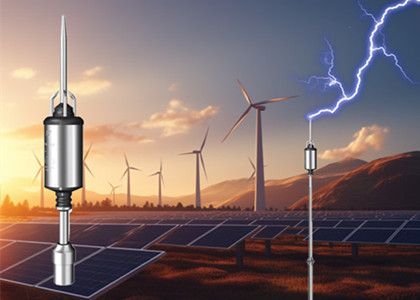
Lightning Protection Solution for BESS Solar Photovoltaic Power Plants
Ⅰ.Project Overview
The photovoltaic power plant with energy storage covers an area of approximately [X] square meters, with a total installed capacity of [X] MW. It includes core facilities such as photovoltaic module arrays, energy storage battery container, inverter rooms, box-type transformers, control rooms, and related transmission lines.The power plant is located in [specific location], where the average number of thunderstorm days per year is [X] days, belonging to [thunderstorm level, such as medium/multiple thunderstorm areas]. Lightning activity is relatively frequent, posing a significant threat to the safe operation of power plant equipment.To effectively prevent lightning disasters, reduce equipment damage, power outage losses, and safety risks caused by lightning strikes, this lightning protection plan is specially formulated.
Ⅱ.Lightning hazard analysis
The harm of lightning to energy storage photovoltaic power plants is mainly reflected in three forms: direct lightning, induced lightning, and lightning wave intrusion, as follows:
Direct lightning strike hazard: Lightning directly hits tall facilities such as photovoltaic modules, energy storage battery compartments, box transformers, transmission line towers, etc. The strong current generated in an instant can cause equipment to burn out, structural damage, and even secondary disasters such as fires and explosions. For example, when a photovoltaic module is struck by a direct lightning strike, it may cause the battery cells to break down, the packaging material to melt, and directly lose its power generation function
Inductive lightning hazard: The strong electromagnetic field generated during lightning discharge can induce high voltage pulses on the power plant's lines (including power lines, signal lines, control lines) and equipment metal casings.Although this type of induced overvoltage is not as strong as direct lightning strikes, it has a wide range of propagation and is prone to invade the interior of precision electronic devices such as inverters, energy storage battery management systems (BMS), monitoring equipment, etc., damaging their core components such as chips and circuit boards, resulting in equipment failure or data loss.
Harm of lightning wave intrusion: When lightning strikes transmission lines, communication lines, etc. outside the power plant, it will form lightning waves and invade the inside of the power plant along the lines, impacting key power equipment such as transformers, inverters, and switchgear, which may cause insulation breakdown of the equipment, trigger large-scale power outages, and even affect the stable operation of the power grid.
Ⅲ.Lightning protection design basis
The design of this plan strictly follows relevant national and industry standards and specifications to ensure the scientific, effective, and compliant nature of lightning protection measures. The main basis includes:
《Design Code for Lightning Protection of Buildings》(GB 50057-2010)
《Design Specification for Photovoltaic Power Stations》(GB 50797-2012)
《Technical Code for Lightning Protection and Grounding Design of Power Engineering》(DL/T 5408-2009)
《Design Specification for Energy Storage Power Stations》(GB 51048-2014)
《Design Specification for Grounding of Communication Electrical Devices》(GB/T 50065-2011)
《Lightning protection - Part 1: General principles》(GB/T 21714.1-2015)
Ⅳ.Design scheme for lightning protection system
Based on the characteristics of facilities in various areas of the power plant and the forms of lightning hazards, this plan adopts a comprehensive lightning protection system of "direct lightning protection+induced lightning protection+grounding system+lightning wave intrusion protection" to achieve all-round protection for the entire area and equipment of the power plant.
(Ⅰ)Direct lightning protection design
The core of direct lightning protection is to set up lightning protection devices to direct lightning directly to oneself, and then safely discharge the lightning current into the ground through the down conductor and grounding system to avoid lightning hitting the protected equipment.
1. Photovoltaic module array direct lightning protection
The photovoltaic module array adopts a combined protection method of "independent lightning rod+photovoltaic bracket grounding":
At high positions around and in the middle of the component array, independent flashing rods are calculated and set according to the rolling ball method. The lightning rod is made of hot-dip galvanized round steel with a diameter of not less than 16mm, and its height is determined according to the protection range to ensure that its protection radius fully covers the photovoltaic module array. An independent foundation is set at the bottom of the lightning rod to maintain a sufficient safe distance from the photovoltaic bracket foundation.
The photovoltaic module bracket is made of hot-dip galvanized steel, and all brackets are equipotential connected through galvanized flat steel (thickness not less than 4mm, width not less than 40mm) to form a continuous conductive network. The bracket is reliably connected to the grounding system, and the grounding resistance is not greater than 4 Ω.When lightning approaches the component array, the lightning rod will be given priority for lightning protection, and the bracket grounding can assist in leakage to prevent the components from being hit by direct lightning strikes.
2. Energy storage battery container transformer direct lightning protection
Outdoor enclosed facilities such as energy storage battery compartments and transformer boxes adopt the protection method of "lightning strip+metal shell grounding":
Hot dip galvanized lightning strips shall be installed at the top edge of the battery compartment and transformer box. The lightning strips shall be made of round steel with a diameter of not less than 12mm or flat steel with a cross-section of not less than 100mm ² (thickness of not less than 4mm). The connection between the lightning strips shall be made by lap welding, with a lap length of not less than 6 times the diameter of the round steel or 2 times the width of the flat steel, to ensure a firm and reliable connection.
The metal casing of the battery compartment and transformer box serves as an auxiliary lightning arrester, which is reliably connected to the lightning strip and grounding system. The movable parts such as doors and windows of the shell are connected to the main shell through copper braided wire to ensure conductivity continuity, and the grounding resistance is not greater than 4 Ω.
3. Direct lightning protection for control room and inverter room
The control room and inverter room are brick concrete or steel structure buildings, and adopt the roof lightning protection method of "lightning strip+lightning protection network":
Install lightning strips at high places such as the parapet and ridge of the building roof, with the same specifications as the battery compartment lightning strips. At the same time, a lightning protection network should be laid on the roof, with a grid size of no more than 10m × 10m or 12m × 8m, and the lightning protection strip should be connected to the lightning protection network to form a complete lightning protection system.
The metal components of the building, such as roof fans, ventilation metal frames, etc., are reliably connected to the lightning protection system to ensure that all objects protruding from the roof are within the lightning protection range. The metal doors and windows on the exterior walls of the building are connected to the grounding system with equipotential to avoid harm caused by lightning induction.
4. Direct lightning protection for transmission lines
The internal transmission lines of the power plant adopt the protection method of "overhead ground wire+tower grounding":
Two overhead ground wires (lightning rods) shall be installed at the top of the tower of 10kV and above overhead transmission lines. The overhead ground wires shall be made of steel core aluminum stranded wire with a cross-section of not less than 50mm ², and their mechanical strength and conductivity shall meet the requirements for leakage.
The transmission line towers are made of hot-dip galvanized steel, and the bottom of the towers is connected to the grounding grid through grounding electrodes. Each tower is equipped with an independent grounding device, and the grounding resistance is not greater than 10 Ω. The overhead ground wire is reliably connected to the tower, ensuring that lightning current can quickly leak into the ground through the tower after lightning strikes the overhead ground wire.
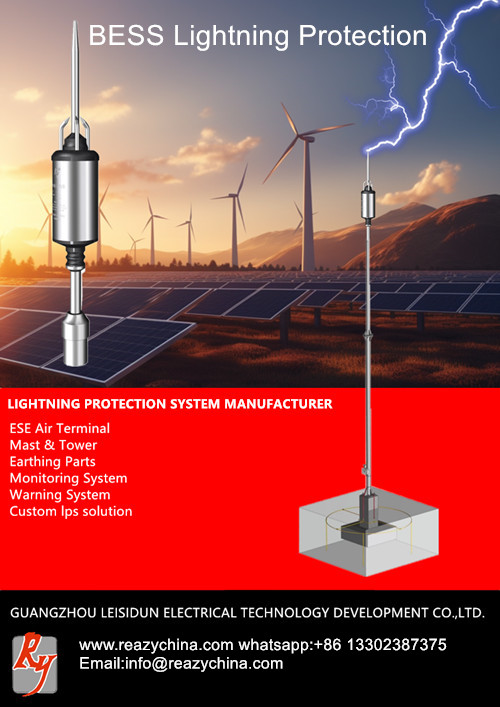
China Leisidun Electrical Technology offer turnkey solution for BESS Battery Energy Storage System, Photovoltaic Power Plant and Wind Turbine Power plant direct lightning protection solution and surge protection,from the ESE advance discharge air terminal,portable lightning support mast,down conductor,earthing bit,earthing rod,earthing copper tape,grounding tester,exothermic welding module and powder etc...